Japanese venison flavor and use
Japanese venison can be lean, clean, and useful when handled well. The buying questions are cut, age, fat, processing, freezing, and a cooking plan that respects how little margin lean meat has.
By Matt Ketchum, founder and editor
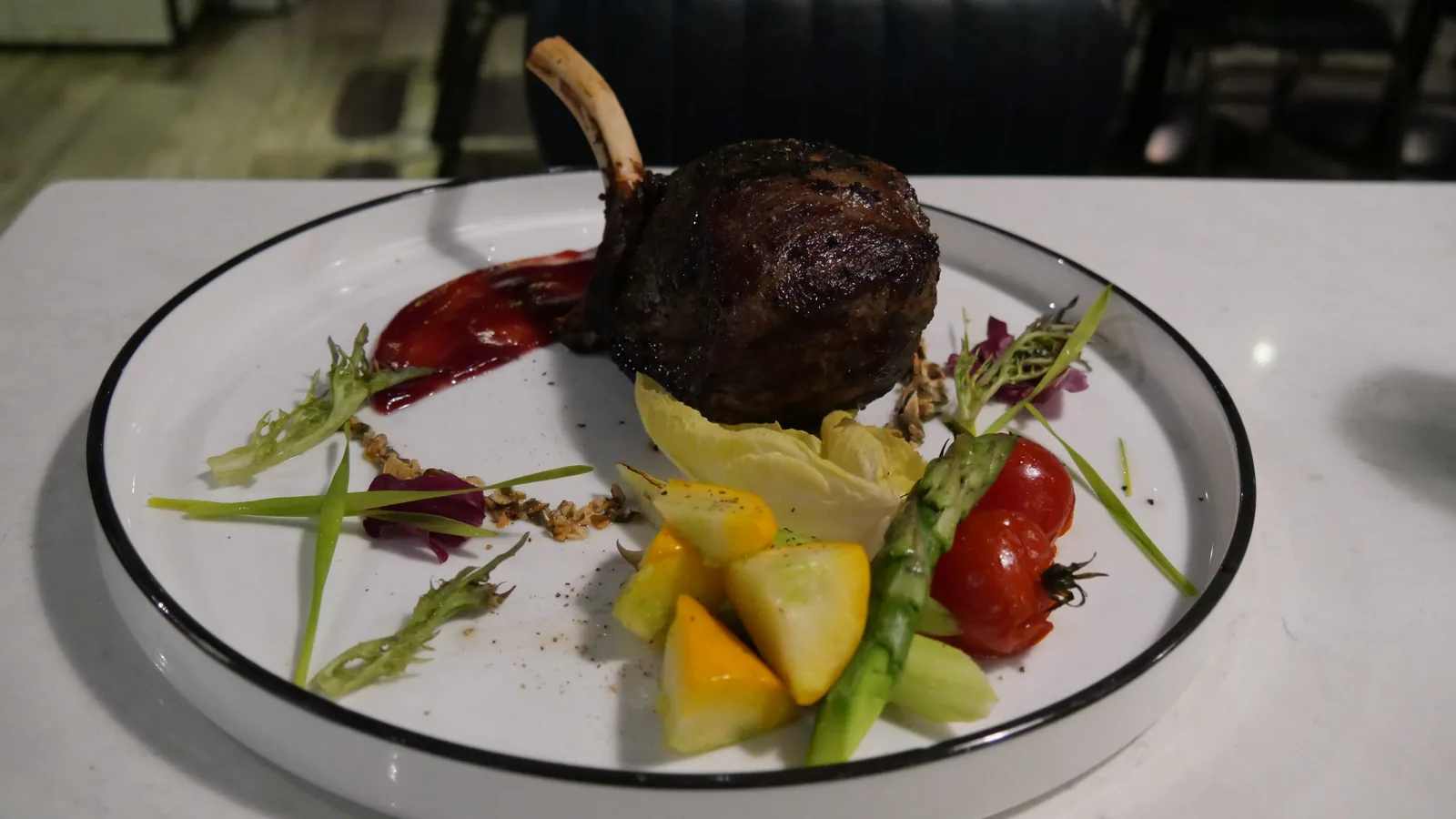
Image credit: Deer steak with vegetables and wine sauce by Peachyeung316, CC BY-SA 4.0
Short answer
Japanese venison is meat from wild sika deer, the largest source of gibier in Japan. MAFF counts about 740,000 deer captured in FY2024, and deer caused ¥7.9 billion of that year’s crop damage, more than any other species. The meat is lean and fine-grained, with an iron-forward flavor that stays clean when the animal was bled and chilled fast. With little fat to protect it, venison dries out quickly when overcooked, yet MHLW guidance still requires thorough heating: 75°C at the center for one minute, or an equivalent time and temperature. That equivalence leaves room for controlled low-temperature cooking held long enough to reach the same effect. For a restaurant, the useful questions are the cut, processing date, chilled or frozen state, the processor’s license, and how much variation to expect between animals and seasons. It works best as a precise red meat, not a generic wild-food symbol.
Why is venison hard to cook well?
Venison is often described as rich or wild, but the most useful starting point is simpler: it is lean. That makes handling and cooking less forgiving than pork or beef with more fat. Good venison can be clean and quiet, but overcooking makes it dry fast, and the safety rule of 75°C at the center for one minute, or an equivalent time and temperature, sets the floor for doneness.
Flavor depends on season, age, sex, handling speed, and cut. Hokkaido’s Ezo deer and Honshu sika deer are the same species at different sizes, and an older animal or one that waited too long before chilling cooks differently from a young, fast-handled one. A supplier who can explain those differences is more useful than one who only says the meat is local.
Which venison cut suits which dish?
Restaurants name the job before ordering. MAFF’s Domestic Gibier Certification uses a standard cut chart, so certified processors label cuts consistently. Tender cuts can stay simple; tougher cuts earn their place in braises, sausage, ragù, curry, or dumpling filling, and mince takes fat or moisture from the recipe.
| Cut | Japanese | Character | Good uses |
|---|---|---|---|
| Loin | ロース | Tender and very lean | Roast, grill, or sear, held to a safe core temperature |
| Tenderloin | ヒレ | Most tender, small yield | Quick roast, cutlet |
| Leg | モモ(内モモ・外モモ・シンタマ) | Lean, larger and firmer muscles | Roast, ham, thin slices for hot pot, katsu |
| Shoulder | ウデ | More connective tissue | Braise, curry, ragù |
| Shank and neck | スネ・ネック | Tough and gelatin-rich | Long braise, stock |
| Trim | 端肉・ミンチ | Variable and very lean | Mince, sausage, dumplings with added fat |
What do restaurants ask venison suppliers?
The order questions are cut, block or sliced format, processing date, chilled or frozen state, the processing facility and its permit, and whether the supply is occasional or repeatable. Deer are captured year-round under damage-prevention permits, so frozen supply often exists outside the November to February hunting season.
Home buyers look for a processor with clear storage and cooking notes. The meat thaws slowly in the refrigerator, is heated through as MHLW requires, and is not the same product as fatty supermarket beef.
Go deeper
- What gibier means in Japan: Gibier guide
- Japanese wild boar flavor: Ingredient guide
- Types of Japanese gibier: Gibier guide
Sources and further reading
- Recent situation around utilization of captured wildlife as gibier, June 2026: Ministry of Agriculture, Forestry and Fisheries (JA)
- MAFF gibier utilization promotion: Ministry of Agriculture, Forestry and Fisheries (JA)
- MHLW gibier hygiene management guidance: Ministry of Health, Labour and Welfare (JA)
- Guideline on hygiene management of wild game meat (summary): Tokyo Metropolitan Government Bureau of Public Health (JA)
- Domestic Gibier Certification: Ministry of Agriculture, Forestry and Fisheries (JA)
Need a sourcing check?
Send the specific context behind your decision. A free inquiry checks fit; the paid sourcing assessment works through one concrete question.