Noto Seien’s low-temperature salt
Noto Seien’s Suzu workshop describes a non-direct-fire process: seawater held around 50°C, roughly six days of concentration and crystallization, and about 80 kg of salt from three tonnes of source water.
By Matt Ketchum, founder and editor
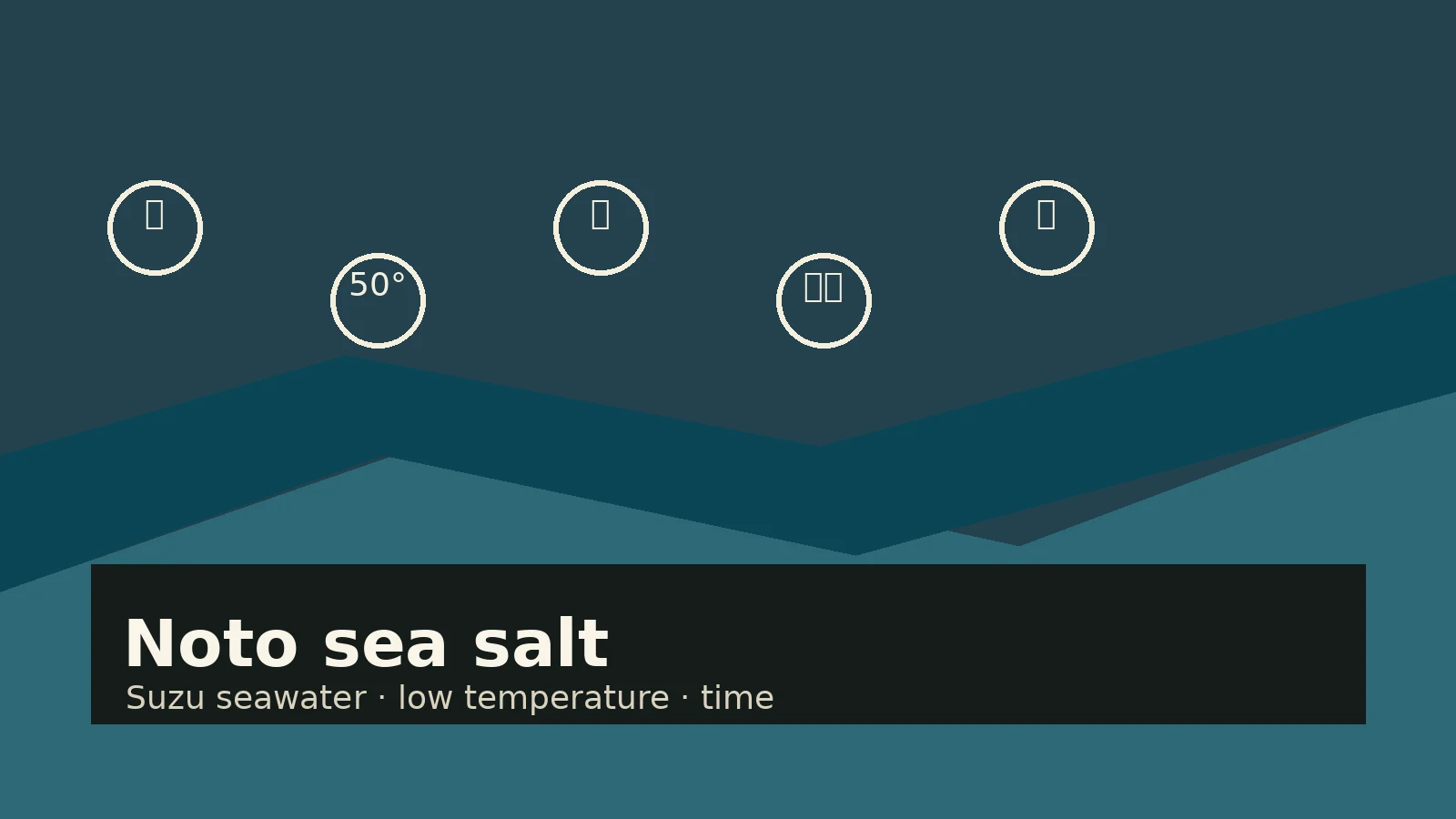
Image credit: Noto low-temperature salt illustration by wildfood.jp, Original site artwork
Where does Noto Seien’s salt come from?
Noto Seien describes its salt as coming from seawater at a workshop in Kataiwa, Suzu, on the Noto Peninsula. The company page places the business in Ishikawa’s Noto region, notes a 1999 founding, and says production stopped after the 2024 earthquake before the company restarted under a new generation.
The important point is not a vague claim that sea salt is somehow better. The useful point is place and method: Suzu seawater, a small producer, and a process the company explains in concrete steps. That gives cooks and buyers something to test rather than a wellness slogan to repeat.
How does the low-temperature method work?
Noto Seien says it does not put seawater directly over flame. Its process uses a two-layer flat pan, indirectly warming the seawater at around 50°C. The company says the source water is concentrated over about four days, moved to a finishing tank, managed so difficult-to-dissolve calcium sulfate is removed under its quality standard, and harvested around the sixth day.
The numbers are useful: the page says three tonnes of source water produce about 80 kg of salt. That is the kind of detail a serious buyer can remember. It explains why this is not commodity seasoning, and why the salt shows itself in simple uses before it disappears inside a heavily seasoned dish.
How do you taste this salt?
For wild food, a salt like this shows its grain where texture and finishing matter: sliced grilled boar, venison steak rested and cut thin, rice balls, grilled vegetables, clear soup, or a small dish of pickles. The question is not whether it contains a magic mineral story. The question is whether the grain, dissolution, and aftertaste help the ingredient read cleaner on the plate.
If a shop carries it, the practical label is: Noto, Suzu seawater, non-direct-fire low-temperature concentration, about six days, and the producer’s post-earthquake restart. That is enough. The salt already has a place and a process; it does not need inflated health language.
Go deeper
- Useful wild food for restaurants: Field note
- Japanese wild boar flavor: Ingredient guide
Sources and further reading
- Noto Seien page on its salt and production method: Noto Seien (JA)
- Noto Seien company and mission page: Noto Seien (JA)
Related video / media
- Illustration: Noto low-temperature salt illustration: wildfood.jp
Need a sourcing check?
Send the specific context behind your decision. A free inquiry checks fit; the paid sourcing assessment works through one concrete question.